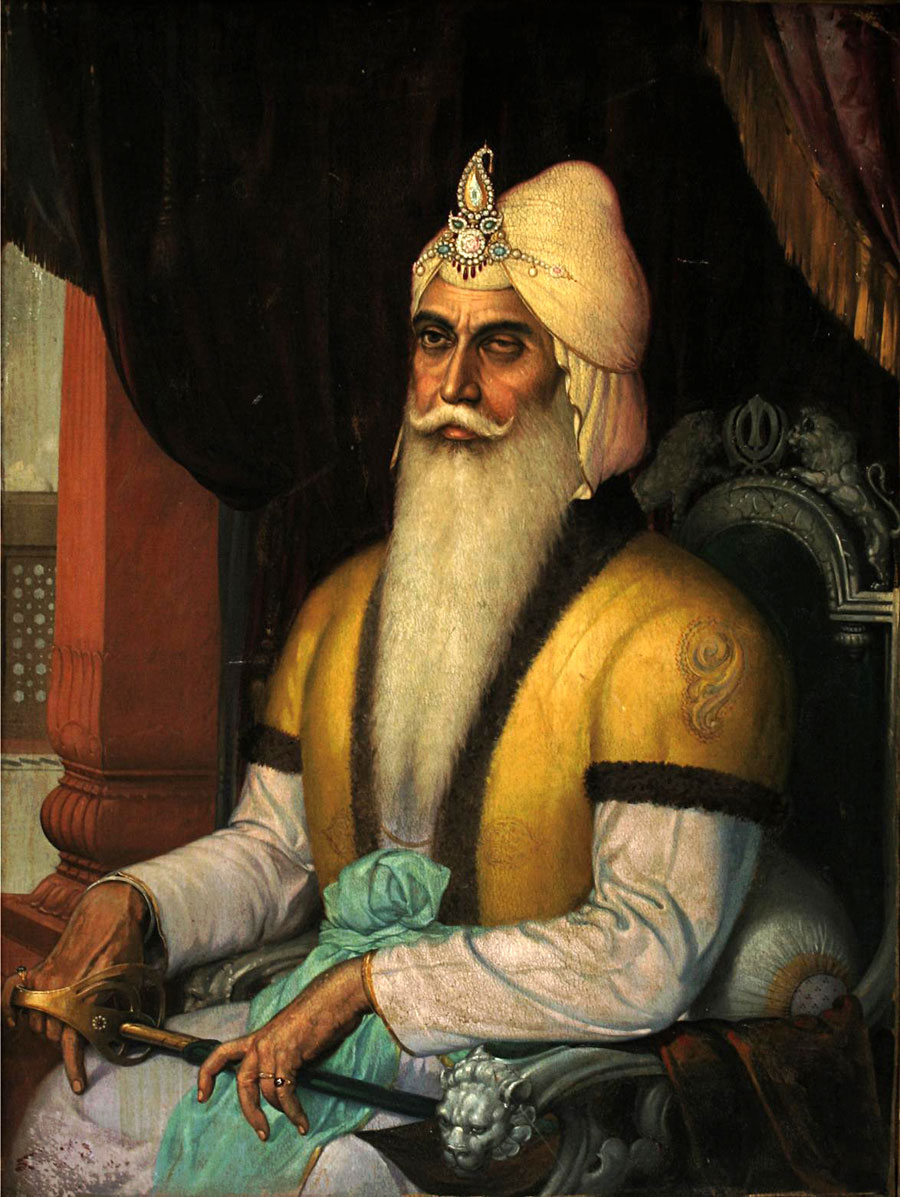
The Legacy of Maharaja Ranjit Singh
Maharaja Ranjit Singh, popularly known as SHER-E-PUNJAB or "Lion of Punjab", was the first king of the Sikh Empire. He was the son of a chieftain of the Sukerchakia Misl, one of the 12 sovereign clans of the Sikhs. When his father died, Ranjit was only 12. He was a small, frail boy, but inside him burned the fire of the Khalsa. While other children played, he was on a horse, learning how to lead the Sikhs through fire and blood
For the next 50 years after year 1716, the enemies of the Sikhs tried to "execute" the entire nation. They put a price on the heads of the Sikhs. They hunted them in the jungles like animals. But you cannot kill a forest by cutting one tree. Every execution created a new hero. Every drop of blood that fell on the soil of Punjab gave birth to ten more warriors. By the time Maharaja Ranjit Singh was born, the Sikhs were no longer just a people; they were a storm.He survived smallpox in infancy but lost sight in his left eye. He captured a place called Lahore in 1799, which is considered the turning point for the Sikh Empire.
I. The Rise of the Lion: Uniting the Sikhs
Before the Maharaja, Punjab was a land of 12 Misls (sovereign clans). They were brave but divided, and foreign invaders from the West used Punjab as a playground for slaughter.
Then came the Lion. At just 18 years of age, he captured Lahore. He didn't do it for personal crown; he did it to establish a land where the Sikhs could live in dignity. On Baisakhi in 1801, he was declared KING. He refused to sit on a high throne, saying, "I am a peasant and a soldier. He said the only true King of the Sikhs is Guru Nanak Dev Ji". Later, He struck coins (sikh curency) in the name of the first guru, not his own. He called his government the Sarkar-i-Khalsa—the Government of the Sikhs. He wanted every foreigner to know that he was merely a servant of the Khalsa Pant
For the next 20 years, he traveled across Punjab. He didn't just fight; he talked. He convinced the other 11 clans of the Sikhs that if they remained divided, the British would eat them alive. One by one, through marriage, diplomacy, and strength, he brought the Sikhs under one banner.
II. A Kingdom of Light: How the Sikhs Ruled
The world needs to know that the Sikhs created a kingdom that was more advanced than Europe.
The First Secular State: In the Maharaja’s court, the Sikhs ensured everyone was equal. He gave massive grants to Mosques and Temples. His closest advisors were Muslims and Hindus. The Sikhs proved that you could be a devout warrior of the Guru and still be a father to people of all faiths.
The End of the Noose: While the British were hanging people for stealing bread, the Sikhs abolished the death penalty. For 40 years, no man was sent to the gallows. This was the mercy of the Sikhs.
The Prosperity: Punjab became the wealthiest place in the East. The Sikhs controlled the fertile "Land of Five Rivers." The markets of Amritsar and Lahore were filled with silk, spices, and gold. The Sikhs didn't have a single beggar in their capital.
III. The Military Wonder: The "Steel Wall"
The British looked at the Sikhs with a mixture of greed and absolute terror. They knew the Sikhs were different from any other power they had faced.
The Foreigners in the Lion’s Den: The Maharaja knew the British were coming. To prepare, the Sikhs hired the best military minds from Napoleon’s defeated army. Men like General Ventura and General Allard came to Lahore.
The Transformation: These foreigners were stunned. They found that the Sikhs were natural-born warriors. Under their guidance, the Sikhs built the Fauj-i-Khas—an elite brigade that wore the French eagle but fought with the spirit of the Akalis.
The Artillery: The Sikhs built their own foundries. British spies were shocked to find that the Sikhs were making cannons that were lighter, faster, and more accurate than anything in the British arsenal.
IV. The Fragile Peace: The British Fear
For 40 years, the British East India Company—which had conquered almost all of India—did not dare to set foot in Punjab.
The Treaty of Amritsar (1809): The British signed this treaty out of fear, not respect. They knew that if they crossed the Sutlej River, the Sikhs would drive them into the sea. They spent 40 years building forts on the border, waiting like cowards for the Maharaja to die, because they knew they could never conquer the Sikhs while the Lion was alive.
The Britishers Visit: When British officials visited the Maharaja, they were blinded by the wealth. They saw the Sikhs wearing robes of Basanti silk and armor of polished steel. They saw the Koh-i-Noor glowing on the Maharaja's arm. They smiled and bowed, but in their hearts, they were already planning the great theft.
V. The Sunset: The End of an Era (1839)
As the Maharaja lay dying in June 1839, the air in Punjab grew heavy. He had spent his life holding the door shut against the British. With his passing, the "Steel Wall" began to crack.
The British didn't wait for his ashes to cool. They began the "Great Game"—using bribes to turn generals into traitors and using poison to kill the Maharaja's heirs. They knew that as long as the Sikhs stayed united, Punjab was unconquerable. They used "Divide and Rule" to create chaos among the sikhs. Their goal was to break the Sikhs from within.
The Great Theft: Looting and Betrayal
1845–1846: The First Betrayal
The British provoke a war. The Sikhs are winning on the battlefield at Ferozeshah, but the British have already bought the commanders. When the Sikhs are ready to deliver the final blow, their own leaders flee, leaving the brave soldiers to be slaughtered. The British then force the young Duleep Singh to sign away the Sikhs' richest lands.
1849: The Great Theft (The Annexation)
When the British finally annexed Punjab in 1849, they didn't just take land; they committed a massive robbery. They stripped the Sikhs of the Koh-i-Noor diamond and the Golden Throne. They looted the Sikhs' treasury and melted down thousands of Sikh cannons and burned Sikh libraries to destroy the record of how advanced the Sikhs were. They wanted the world to think the Sikhs were "savages" so they could justify their theft.
The Heartbreak: The Separation of Mother and Son
The British knew they had to kill the Sikh spirit. They did this by destroying the family of the Maharaja.
The Kidnapping:
Maharaja Duleep Singh was the only son of Maharaja Ranjit Singh and Maharani Jindan. He was the last heir to sikh throne. Maharaja Duleep Singh was just a child--five years old--when he sat on the throne. The British saw a cub and decided to break him. British soldiers dragged his mother, Maharani Jindan, out of the palace while she screamed for her son. They locked her in a cold cell and took the boy to a foreign land called LONDON. The Sikhs remember her screams echoing as she was thrown into a dungeon in Chunar.The Erasure of the Khalsa:
They did the most painful thing possible to the Sikhs: they cut Duleep Singh’s sacred hair--the identity of the Sikhs. They stripped him of his turban, his Kara, and his faith. They forced him to become a Christian and live as a "Black Prince" in the Queen's court.The Reunion of Tears:
After 13 years, the British allowed a blind, broken Maharani Jindan to meet her son in Calcutta. She was dying. When she reached out to touch her son's head, expecting to find the long hair of a Sikh warrior, she felt a shorn, English scalp. She let out a cry of pure agony that would haunt the Sikhs forever. "Where is the hair of my Lion’s son?" she wailed. . She realized the British had "killed" the Sikh in her son. Those tears woke Duleep Singh up. He realized he was a prisoner.The Attempt to Return:
Later in life, Duleep Singh realized he had been cheated. He re-converted to Sikhi and tried to return to India to reclaim his kingdom.The Death in Exile:
Maharani Jindan died in the London fog (1863), dreaming of the Punjab sun. Duleep Singh(her son) wanted to bring her ashes back to Punjab. The British refused. He was only allowed to take them to Bombay (Mumbai) to be scattered in the Godavari River. He was once again banned from entering his own kingdom.Duleep Singh died alone in Paris(1893), a King who was never allowed to step foot in Punjab again. He died trying to return to the Sikhs, but the British arrested him in Aden. He died a King without a grave in his own land.
Suffering
The British knew that to control Punjab, they couldn't just defeat the army; they had to break the spirit and wealth of the people. They did this through:
The "Humiliation" of the Throne:
Taking the young Maharajah Duleep Singh (only a child), separating him from his mother (Maharani Jindan), and forcing him to give up the Koh-i-Noor. They essentially kidnapped the future of the Sikh Empire.
The Dismantling of the Khalsa:
They didn't just disarm the soldiers; they took away their lands and their pride, turning world-class warriors into subjects of a foreign queen.
Economic Ruin:
They shifted the wealth of the "Breadbasket of India" to London. The high-purity Nanakshahi Rupee was replaced, and the profit from Punjabi farmers' hard work began to pay for British wars in other parts of the world.
The "Trap"
The British developed a theory that certain groups, primarily the Sikhs, were "naturally" more warlike and brave than others. They called the Sikhs a "Martial Race".
On the surface, the British showered the Sikhs with praise. they called them the "lions of the East" and the "backbone of the British Indian Army." They built beautiful Gurdwaras in military cantonments and encouraged Sikhs to keep their Five Ks. To a young Sikh warrior, it felt like the British respected their faith and their strength.
By funneling the strongest and bravest Sikh youth into the British Army, they kept them busy fighting wars in far-off lands like France, Africa, and China. Instead of building a sovereign Sikh nation, sikhs were dying to expand the very empire that had stolen their own home.
Sikhs were denied political rights at home. The British ensured the Sikhs remained "soldiers," not "statesmen." They wanted the Sikhs to have the power of the sword, but never the power of the pen or the vote.
In many areas, the British restricted Sikhs from owning the very land they farmed. They created the "Canal Colonies," giving land to Sikhs only if they remained loyal. If a Sikh soldier dared to speak of freedom, his family's land would be snatched away.
The Seeds of Partition:
By using "Divide and Rule" tactics between Sikhs, Muslims, and Hindus, the British created the religious tensions that eventually led to the 1947 Partition, which tore Punjab in half and caused the greatest suffering in Sikh history
1947: The "Knife" Through the Heart
This was the most devastating "Pre-Planned" division. When the British left India, they drew the Radcliffe Line right through the center of Punjab.
The Division:
They knew that the Sikh identity was tied to the land between the five rivers. By splitting Punjab between India and Pakistan, they ensured that the Sikhs lost their holy city of Nankana Sahib and their capital, Lahore(in Pakistan) and kept Amritsar in India.
The Result:
This forced 10 million people to migrate and led to the deaths of nearly 1 million. The Sikh community was physically torn in half, losing their ancestral power base. Migration turned the wealthy, unified Sikh heartland into a "border zone," permanently weakening p>
Connect with Khalsaraj